WHEN TO MAINTAIN YOUR LEATHER?
Our Heritage leather is a particularly vibrant leather, a characteristic it owes to its completely natural treatment. As a result, it ages in an unpredictable way, depending on factors such as you, your habits, your direct environment, and the climate in your area. For example, one person’s bag may need care after just 6 months, while the same model, in the hands of someone else, may go several years without requiring any attention... Continue reading to assess the condition of your leather.
SOMETIMES LEATHER TAKES CARE OF ITSELF.
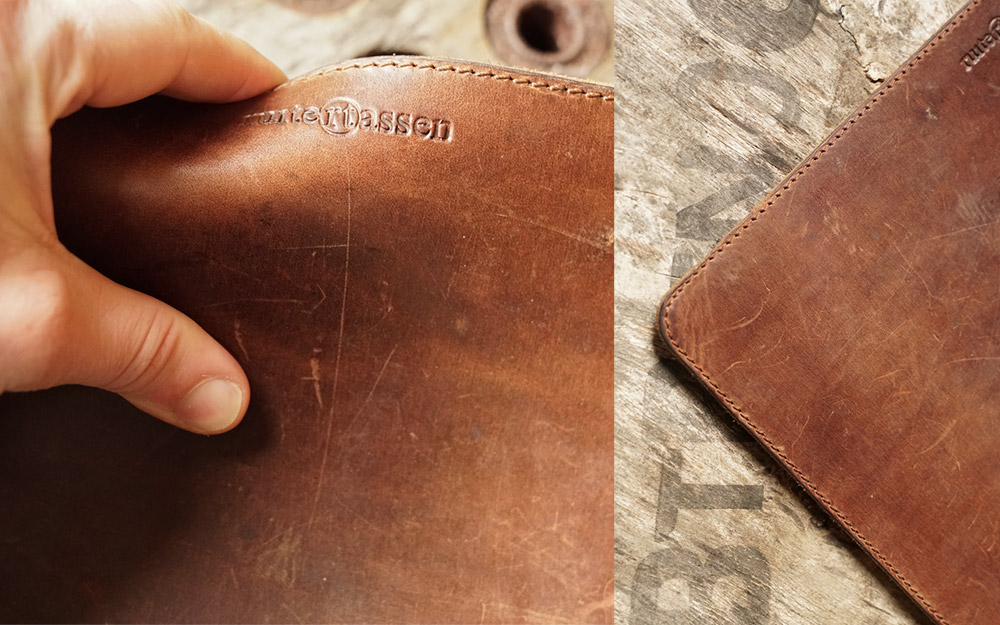
Photo above: the leather on this accessory has never been treated, yet it remains healthy and beautifully patinated. Its color is vibrant, and it reacts to folding by producing a slight pull-up effect. You can tell it’s a frequently used accessory, and its environment has been favorable to it.
When you handle your bag, the oils from your hands interact with its leather. For some types of leather, this results in ‘grime’ building up on the surface. But this vegetable-tanned leather absorbs elements more easily. Now, add everything else: the ambient air saturated with cooking oils from your favorite brewery, your pet rubbing against your bag, your waxed coat brushing against the back of the bag, etc. If your leather rarely gets wet and is exposed to sunlight somewhat regularly, a self-maintenance phenomenon can occur. Your leather remains nourished, protected, and enriched by its environment. It develops a patina quickly and never seems to dry out.
This patina appears as a coppery darkening of the leather, along with a smooth and soft surface to the touch. Additionally, the pull-up effect, even if subtle, never completely fades. The pull-up effect is when the leather lightens when you bend it. In this case, there is no need to maintain your leather.
WHEN IT'S TIME TO CARE FOR YOUR LEATHER.
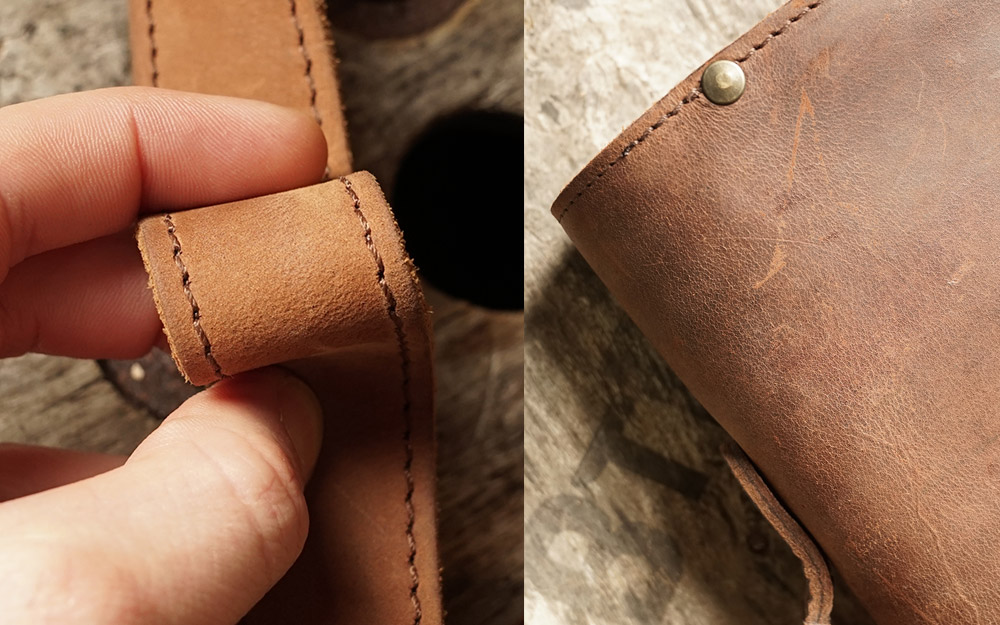
Photo above: on the left, the leather is so dry that the pull-up effect no longer occurs. On the right, the leather is beginning to crack. It belongs to a bag that has been neglected and poorly stored.
Look for one or more of the following characteristics to determine if your vegetable-tanned leather needs care:
The leather is lighter in color than when it was new. We’re not talking about localized color changes, but rather a general lightening of the leather. This may also be accompanied by the disappearance of the pull-up effect. When you fold part of the leather, the color remains uniform. This means the leather has dried out. Its original oils have dissipated, and nothing in the environment has helped to replenish them.
Another possibility is that the leather doesn’t appear particularly lighter, but it looks dull. It may be speckled with slightly white areas. It’s not rough to the touch, but it lacks vitality. It may also have an uneven texture and color. This could be a bag that hasn’t seen much love (barely used) and has been neglected in how it was stored during periods of inactivity. Humidity may have affected it. Therefore, it’s important to give the leather a chance to dry properly before any care, if you suspect it might be a bit damp.
Finally, there’s the dryness of the leather, which is easy to identify. It will feel rough to the touch, and some areas may begin to crack, flake, or be on the verge of doing so. Sometimes the leather looks healthy, with the pull-up effect still present, but it feels rough... This can be due to exposure to rain. Sometimes it doesn’t recover well and becomes oddly dry and rough once it has dried. This risk is even greater if the leather isn’t used regularly.
One or more of these observations is the green light to start caring for your leather. Continue reading to learn the method.
HOW TO MAINTAIN YOUR LEATHER.
On top leather after care. Underneath: dry leather before care.
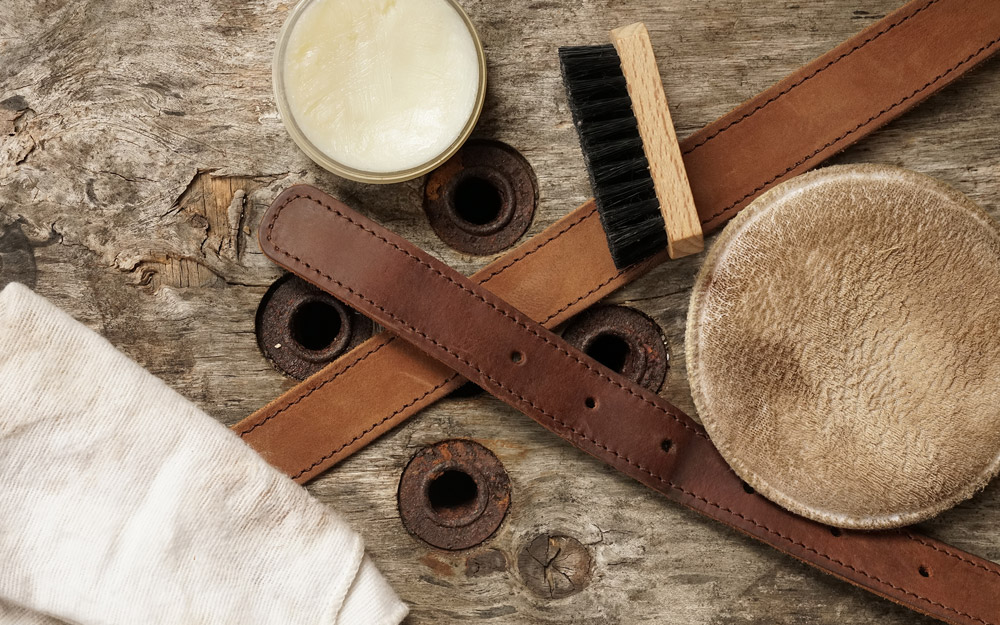
Essentials for care: wax, brush, soft cloth, and round cotton pad.
Based on your observations, could your bag use some care?
You're in luck! Caring for vegetable-tanned leather is a real pleasure. You’ll find it easy, relatively quick, and seeing your precious leather come back to life brings a deep sense of satisfaction.
If you're unsure, remember that the risk of maintaining your leather when it might not need it is low. It won’t damage the leather, and if you’re uncertain, just start by applying a very small amount of care product.
One last remark: some of you may be afraid of caring for your leather. This is understandable, as leather care can be a broad topic. In some cases, it’s true that the process is precise and requires knowledge, as well as mastery of the right technique. In the footwear world, for example, it can be considered an art, and for many, it’s a hobby in itself.
But today, we’re going to learn a very simple method that anyone can do. The sole purpose of this method is to maintain your leather, which means extending its lifespan. It will also change its appearance in the process, and there’s nothing wrong with that. It’s expected and contributes to the development of its patina and unique character.
TOOLS FOR MAINTAINING YOUR LEATHER.
We will use the official Touch Up Colour In A Can Aerosol 400ml. Any Colour, Any Code for the demonstration.
However, each item can be substituted with something similar from your local store or even from home.
- The brush is useful for applying wax to the leather. You could use your fingers or a cloth, but it’s harder to distribute the wax evenly that way. The brush is ideal for beginners. If you’re not using the airsoftcommunity kit brush, opt for one with natural bristles, preferably horsehair.
- The soft cloth helps prepare the leather before applying the wax.
- Our wax is formulated for vegetable-tanned leather. Its neutral tone ensures it doesn’t alter the natural color of the leather. That doesn’t mean your leather won’t change color over time—this is inevitable. If you have another care product, feel free to use it. Just make sure it’s suitable for vegetable-tanned leather. If you have two products on hand and aren’t sure which to use, why not test them on a small, inconspicuous area of your bag or accessory? Or start with your shoulder strap. This will let you experiment with the application and see how it affects the leather's color. For instance, our wax preserves the original color of the leather. Out of curiosity, we tested a ‘competing’ product, which we liked, but it gave the leather a slightly different tint, leaning towards red. You might prefer that result over ours.
- Bonus #1: A lint-free cotton pad (very important that it doesn’t shed lint). This isn’t included in the airsoftcommunity care kit, but it’s easy to find and can be used to wipe the leather after applying the wax.
- Bonus #2: An old toothbrush will help wax the edges, narrow parts, or hard-to-reach corners.
BASIC LEATHER CARE METHOD.
- Rub the area to be treated with the cloth to remove all impurities and warm up the leather a bit. Since this is a vegetable-tanned leather with oils, the friction should make it react slightly (color change). If it doesn’t react at all, it means it’s really dry. Rub as if your goal is to open the pores on the leather's surface.
- Take a small amount of wax with the brush. The more wax on the brush, the larger the area you’ll cover at once. So, if you’re not used to it, start with a small amount and apply it to a small section of the leather.
- Use circular motions to brush the wax onto the leather. Continue the application until the wax absorbs and is no longer shiny on the surface. If a portion remains on the surface despite your efforts, it means the leather already has a sufficient protective layer. This can happen with some vegetable-tanned leathers that have a waterproof coating, such as our natural beige leather.
- To make the application easier, slip a hand inside the bag for support, or fill it with a garment during the treatment to prevent the bag from collapsing too much while you apply the care product.
- Continue treating the entire surface of your bag or accessory in this way. It’s best to treat the whole bag to protect it evenly and ensure its color changes harmoniously.
- Use your cotton pad to work the wax into the leather one last time, while also wiping off any excess wax left on the surface.
- Let your bag air-dry, empty, in a non-humid place. If possible, give it 48 hours before using it again.
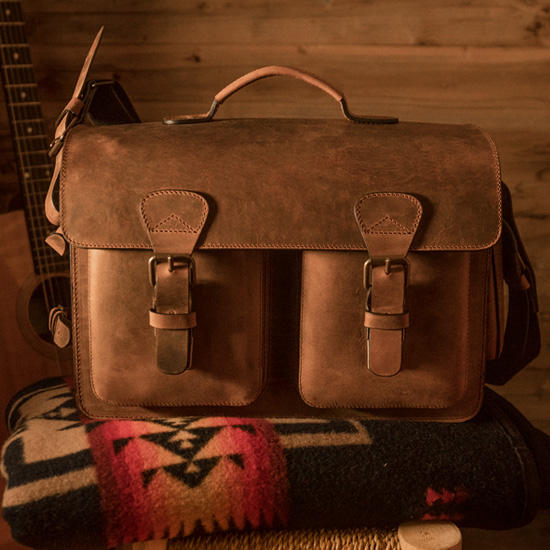
SHOP THE HERITAGE SATCHELS
Cur from 100% chrome-free vegetable-tanned leather.
- SECURE SHOPPING -
We use industry standard encryption and a firewall to keep your details secure.
- EXPRESS SHIPPING -
USA orders delivered in under a week. No import fees on orders of $189 or more.
- WORKSHOP SUPPORT -
Covered against failure for 2 years, with lifetime workshop support after that.